

Chengde Rui Mai—Your Professional Gate Valves Supplier
Our company is committed to producing high-quality metal valves to meet the needs of various industries. We are constantly improving our products to meet customer needs. Our goal is to be the best partner for our customers.
More than 20 countries and regions including the United States, France, Turkey, Russia, Malaysia, India, Pakistan, Indonesia, and South Africa. We always look forward to establishing long-term partnerships with customers for mutual benefit. When you need help with your valves, just send us an email or give us a call today.
-
![F4 Non-Rising Stem Resilient Gate Valve-L]() F4 Non-Rising Stem Resilient Gate Valve-LSize: DN40-DN300. Operation: Hand wheel. Working pressure: PN16. Temperature Range: -15°C - 80°C. Face to Face: DIN3202-F4. Flange drilled: DIN2501 PN10/16.read more
F4 Non-Rising Stem Resilient Gate Valve-LSize: DN40-DN300. Operation: Hand wheel. Working pressure: PN16. Temperature Range: -15°C - 80°C. Face to Face: DIN3202-F4. Flange drilled: DIN2501 PN10/16.read more -
![F4 Non-Rising Stem Resilient Gate Valve-H]() F4 Non-Rising Stem Resilient Gate Valve-HDescription The gate of F4 Non-Rising Stem Resilient Gate Valve is made of EPDM or NBR coating, and the valve body is made of epoxy resin coating. The distinguishing feature of this gate valve is that it has an unobstructed passageway,read more
F4 Non-Rising Stem Resilient Gate Valve-HDescription The gate of F4 Non-Rising Stem Resilient Gate Valve is made of EPDM or NBR coating, and the valve body is made of epoxy resin coating. The distinguishing feature of this gate valve is that it has an unobstructed passageway,read more -
![Resilient Gate Valve Hot Water]() Resilient Gate Valve Hot WaterSize: DN50-DN300. Operation: Hand wheel. Working pressure: PN16. Temperature Range: 0 °C - 150°C. Face to Face: DIN3202-F4. Flange drilled: DIN2501 PN10/16.read more
Resilient Gate Valve Hot WaterSize: DN50-DN300. Operation: Hand wheel. Working pressure: PN16. Temperature Range: 0 °C - 150°C. Face to Face: DIN3202-F4. Flange drilled: DIN2501 PN10/16.read more -
![BS5163 Non Rising Stem Resilient Gate Valve]() BS5163 Non Rising Stem Resilient Gate ValveSize: DN40-DN600. Operation: Hand wheel. Working pressure: PN10/16. Temperature Range: -15°C - 80°C. Face to Face: BS 5163. Flange drilled: EN 1092 ISO PN10/16. Hydraulic Pressure Test: Shell test at 1.5 x PN, Seal test at 1.1 x PN.read more
BS5163 Non Rising Stem Resilient Gate ValveSize: DN40-DN600. Operation: Hand wheel. Working pressure: PN10/16. Temperature Range: -15°C - 80°C. Face to Face: BS 5163. Flange drilled: EN 1092 ISO PN10/16. Hydraulic Pressure Test: Shell test at 1.5 x PN, Seal test at 1.1 x PN.read more -
![F4 Non-Rising Stem Resilient Gate Valve-M]() F4 Non-Rising Stem Resilient Gate Valve-MSize: DN40-DN600. Operation: Hand wheel. Working pressure: PN16. Temperature Range: -15°C - 80°C. Face to Face: DIN3202-F4. Flange drilled: DIN2501 PN10/16.read more
F4 Non-Rising Stem Resilient Gate Valve-MSize: DN40-DN600. Operation: Hand wheel. Working pressure: PN16. Temperature Range: -15°C - 80°C. Face to Face: DIN3202-F4. Flange drilled: DIN2501 PN10/16.read more -
![Big Size Resilient Soft Seated Gate Valve]() Big Size Resilient Soft Seated Gate ValveSize: DN350-DN1000. Operation: Hand wheel/Worm gear/Electric actuator. Working pressure: PN10/16. Temperature Range: 0 °C - 100 °C. Face to Face: BS5163/DIN3202-F4. Flange drilled: BS 4504 PN10/16/DIN2501 PN10/16.read more
Big Size Resilient Soft Seated Gate ValveSize: DN350-DN1000. Operation: Hand wheel/Worm gear/Electric actuator. Working pressure: PN10/16. Temperature Range: 0 °C - 100 °C. Face to Face: BS5163/DIN3202-F4. Flange drilled: BS 4504 PN10/16/DIN2501 PN10/16.read more -
![Cast Iron Wedge Gate Valve]() Cast Iron Wedge Gate ValveSize: DN40-DN800. Operation: Hand wheel. Working pressure: PN10. Temperature Range:0 °C - 200 °C. Face to Face: BS 5163/GOST 12815-80. Flange drilled: PN10.read more
Cast Iron Wedge Gate ValveSize: DN40-DN800. Operation: Hand wheel. Working pressure: PN10. Temperature Range:0 °C - 200 °C. Face to Face: BS 5163/GOST 12815-80. Flange drilled: PN10.read more -
![Cast Steel Gate Valve]() Cast Steel Gate ValveSize: DN50-DN600. Operation: Hand wheel. Working pressure: PN16. Temperature Range: -46 °C - 400 °C. Face to Face: GOST 12815-80. Flange drilled: GOST 33259-2015 PN16.read more
Cast Steel Gate ValveSize: DN50-DN600. Operation: Hand wheel. Working pressure: PN16. Temperature Range: -46 °C - 400 °C. Face to Face: GOST 12815-80. Flange drilled: GOST 33259-2015 PN16.read more -
![Wafer Knife Gate Valve]() Wafer Knife Gate ValveSize: DN50-DN1000. Operation: Hand wheel/Worm gear. Temperature Range: 0 °C - 80 °C.read more
Wafer Knife Gate ValveSize: DN50-DN1000. Operation: Hand wheel/Worm gear. Temperature Range: 0 °C - 80 °C.read more


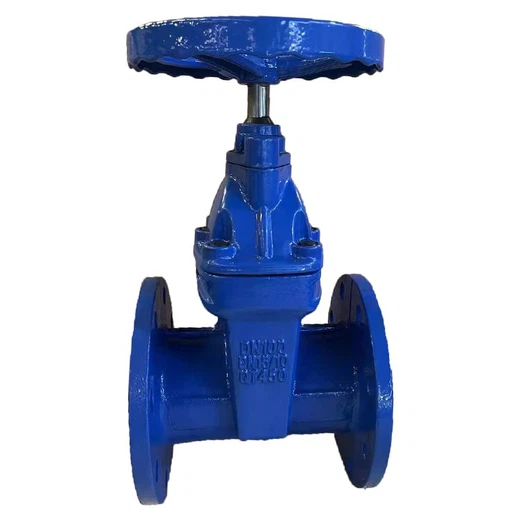
What is a Gate Valves?
Gate valves are the most common valves in water supply systems. It stands for linear motion isolation valve and has the function of blocking or allowing flow. Gate valves are named for their closing element that slides into the flow to provide closure, thus acting like a gate. Gate valves are used to isolate specific areas of a water supply network during maintenance, repair works, and new installations, and to reroute water throughout the pipeline.
Gate Valves Manufacturer
Gate valves use a sliding gate to stop the flow of fluid (sliding gate valve). The design of valve operation and sealing systems often requires that they should operate either fully open or fully closed.
They open by lifting a circular or rectangular gate/wedge out of the fluid path. Its distinctive feature is that the sealing surface between the gate and the valve seat is flat. The gate faces may be wedge-shaped or may be parallel. Generally, they should not be used to regulate flow unless they are specifically designed for that purpose.
When open, the flow path expands in a highly non-linear manner relative to the opening percentage. This means that flow does not vary uniformly with stem travel. In addition, partially opened gates are prone to vibration due to fluid flow. Most flow changes occur near closure, where fluid velocities are relatively high, causing disc and seat wear and eventually leakage if used to regulate flow. Typically, they are designed to be fully open or closed. When fully open, a typical gate valve has no obstructions in the flow path, so friction losses are very low.
They are characterized by having ascending or non-ascending stems. The rising stem provides a visual indication of the valve position. Concealed poles are used where vertical space is limited or underground.
Types of gate valves
According to the structure, gate valves for water supply systems can generally be divided into the following types:
By wedge: parallel gate valve and wedge gate valve
By seat: metal seat or elastic seat gate valve
By stem: With rising or non-rising stem.
Gate valve application
Gate valves have many industrial and residential applications.
Slurry
Gate valves are commonly used in applications where slurry is the media. This is because the fluid passage of the gate valve is unobstructed, so the slurry can pass through the valve easily. Additionally, knife gate valves can easily cut through the slurry to close.
Viscous media
Gate valves are typically used for viscous media such as light greases and oils. Unobstructed channels allow these media to flow easily. Valves can be pigged, which is a common cleaning method for these applications. Additionally, valves used in these applications are often left open or closed for long periods.
Gate valves
For water applications, gate valves are often used because flow control is not typically available in these applications. The valve can be fully open or fully closed for proper water control.
Metal seat or elastic seat gate valve
Wedge gate valves can have metal or plastic seats. In metal-seat gate valves, the wedge slides into a groove in the back of the gate valve body, which often traps solids contained in the fluid. Therefore, resilient seated gate valves provide a tighter closure and are preferred in water distribution systems.
In a resiliently seated gate valve, the wedge is primarily made of ductile iron and is encapsulated in a resilient material (elastomer), thus providing a tight seal. The valve seat is located between the edge of the wedge and the valve body. This does not require a groove in the bottom of the valve. Therefore, elastomeric seated gate valves can seal around small solids carried by the flow of water.
Gate valve working principle
Gate valves are typically operated by a handwheel, a valve T-key (wrench), or an actuator. The wheel connects to the valve stem and transfers rotational energy to it. When the gate valve is opened, the rotation of the handwheel screws the thread of the gate valve stem into the gate plate and vice versa, thus closing the gate valve. This energy moves the gate valve wedge downward or upward. In underground gate valve installations, an extension shaft is attached to allow operation without direct contact with the valve itself.
Typically, gate valves are installed in areas of the pipeline that will remain open or closed for longer periods, as they typically require some time to switch between these two positions. However, when a valve needs to be operated frequently or even remotely, then an electric gate valve (i.e. equipped with an electric actuator) is used.
FAQ
Q1: How does the concealed stem gate valve work?
Q2: How to judge whether the gate valve is open or closed?
Q3: Can the gate valve be throttled?
Q4: How does a gate valve work?
Q5: What is the purpose of the gate valve?
Q6: What is the difference between a gate valve and a globe valve?
Q7: When should not a gate valve be used?
Gate valves are not used to regulate flow – they are designed to be fully open or fully closed. These valves are slower than quarter-turn valves (such as ball valves) because they require more than 360° of rotation to change the gate position, whereas ball valves only need to turn 90° to cycle from open to closed or vice versa. Therefore, gate valves may not be the best choice for applications requiring frequent operation or fast cycle times. Gate valves are most commonly controlled by a manual handwheel, but electric and pneumatic actuation options are also available.
Q8: Why does the gate valve always leak?
Q9: Can a gate valve be over-tightened?
Q10: Why won't my gate valve close completely?
We're professional gate valves suppliers in China, specialized in providing high quality products and service. We warmly welcome you to buy customized gate valves at low price from our factory. For more cheap products, contact us now.
pvc gate valve 6 inch, series 2500 resilient wedge gate valve, sliding gate valve 100mm-
![Stainless Steel Double Disc Check Valve]() Stainless Steel Double Disc Check ValveSize: DN50-DN350 Working pressure: 10/16 bar Temperature range: -20°C - 150°C Connection Ends: BS EN 1092 PN10/16, ASread more
Stainless Steel Double Disc Check ValveSize: DN50-DN350 Working pressure: 10/16 bar Temperature range: -20°C - 150°C Connection Ends: BS EN 1092 PN10/16, ASread more -
![Flanged Ball Check Valve]() Flanged Ball Check ValveSize: DN40-DN300 Working pressure: 16 bar Temperature range: -20°C - 80°C Flange Standard: EN 1092 ISO PN16read more
Flanged Ball Check ValveSize: DN40-DN300 Working pressure: 16 bar Temperature range: -20°C - 80°C Flange Standard: EN 1092 ISO PN16read more -
![F4 Non-Rising Stem Resilient Gate Valve-L]() F4 Non-Rising Stem Resilient Gate Valve-LSize: DN40-DN300. Operation: Hand wheel. Working pressure: PN16. Temperature Range: -15°C - 80°C. Face to Face:read more
F4 Non-Rising Stem Resilient Gate Valve-LSize: DN40-DN300. Operation: Hand wheel. Working pressure: PN16. Temperature Range: -15°C - 80°C. Face to Face:read more -
![F4 Non-Rising Stem Resilient Gate Valve-H]() F4 Non-Rising Stem Resilient Gate Valve-HDescription The gate of F4 Non-Rising Stem Resilient Gate Valve is made of EPDM or NBR coating, and the valve body isread more
F4 Non-Rising Stem Resilient Gate Valve-HDescription The gate of F4 Non-Rising Stem Resilient Gate Valve is made of EPDM or NBR coating, and the valve body isread more -
![Wafer Butterfly Valve-M]() Wafer Butterfly Valve-MSize: DN50-DN300 Working pressure: 16 bar Temperature range: -20°C - 120°C Operation: Handle/Worm gearConnection ends:read more
Wafer Butterfly Valve-MSize: DN50-DN300 Working pressure: 16 bar Temperature range: -20°C - 120°C Operation: Handle/Worm gearConnection ends:read more -
![Stainless Steel Wafer Butterfly Valve]() Stainless Steel Wafer Butterfly ValveSize: DN50-DN300 Operation: Handle/Worm gear/Electric actuator Working pressure: PN16read more
Stainless Steel Wafer Butterfly ValveSize: DN50-DN300 Operation: Handle/Worm gear/Electric actuator Working pressure: PN16read more


